What I'm building to turn AI anxiety into agency
Your CIO can’t fix AI Adoption and neither can McKinsey because the entire adoption industry is built on the wrong premise.

I’m now a month into my entrepreneurial journey at the frontier of AI. It’s been intense.
Crises of anxiety and self-belief offset by moments of unrepentant creativity and joy. Earth-shatteringly great conversations in the morning, ADHD meltdowns over admin in the evening. Sweating buckets over a limited runway and turning them into a river of plans and strategy.
All in all, 10/10 - would recommend.
In my haste though, I realise I never really explained what it is I’m doing. Truth is, I didn’t know – I still don’t have a full handle on it.
This blog sets out to rectify that.
The Problem: AI Adoption is failing
The research is unequivocal: current methods for adoption are not working.
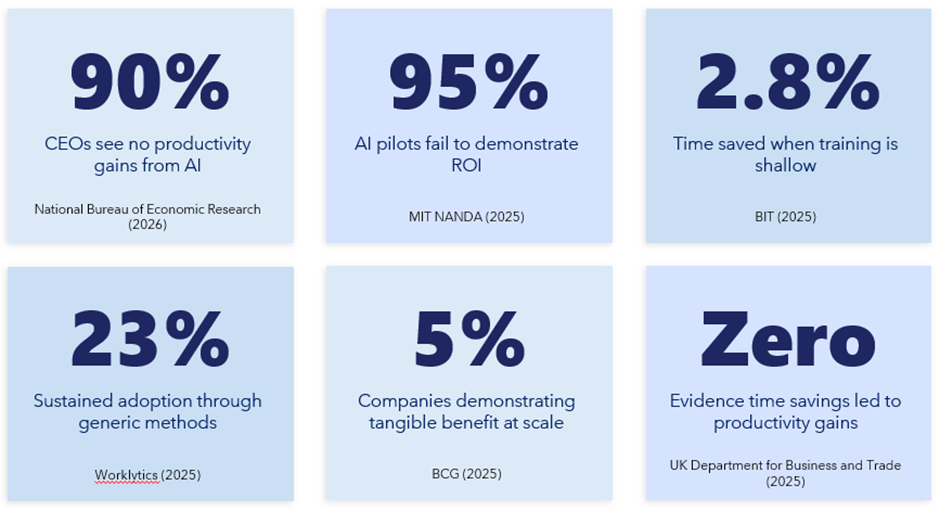
This is a multidimensional failure.
It is a failure to understand risk and to adequately mitigate against it. It is a failure of leadership to articulate a vision which inspires their workforces. It is a failure of AI providers to identify this problem and proactively work to solving it.
You may look at the stats above and say “well AI’s shit” – this in itself would be a false fail. Those who have successfully adopted AI are pulling away at incredible speed – BCG noted that the gap between MIT’s infamous 95% and the 5% of winners is accelerating.
This is because the single biggest failure many are making is not acknowledging what AI actually is – not a tool to be wielded but intelligence to be applied – and to adapt their approach accordingly.
Mismatched skills and misunderstandings
Companies are hiring the wrong people. And this isn’t just my opinion – it’s reflected in the market itself.
Since finishing my last role at the end of January, I’ve applied for over a hundred positions. I’m yet to have a single callback. The problem isn’t my work. The strategy I developed from scratch at Nanopore got results: 286% ROI for enablement, the equivalent of 72 extra FTEs from our ChatGPT cohort of 500. I’ve had people I’ve never met wanting to come and shake my hand for transforming their relationship with AI. One exec I coached recently told me that our three-hour session changed his life. Results like these, as you might gather from the stats above, are not normal.
The problem is that the market doesn’t know what to look for.
Many misunderstand that the challenge of AI adoption didn’t start with computers. It is part of a chain of cultural technology disruptions stretching back to the printing press and writing. It is humanities, not the technical skills CIOs possess, that move the needle. ML chiefs can’t help because the skillsets you need aren’t in data and analytics, but in the social sciences.
90% of CEOs see no productivity gains from AI and blame the tech, but the truth is that they simply do not understand the nature of the challenge.
It is not technical. It is psychological.
Anxiety to agency
There’s one word which sums up why AI adoption is stalling: fear.
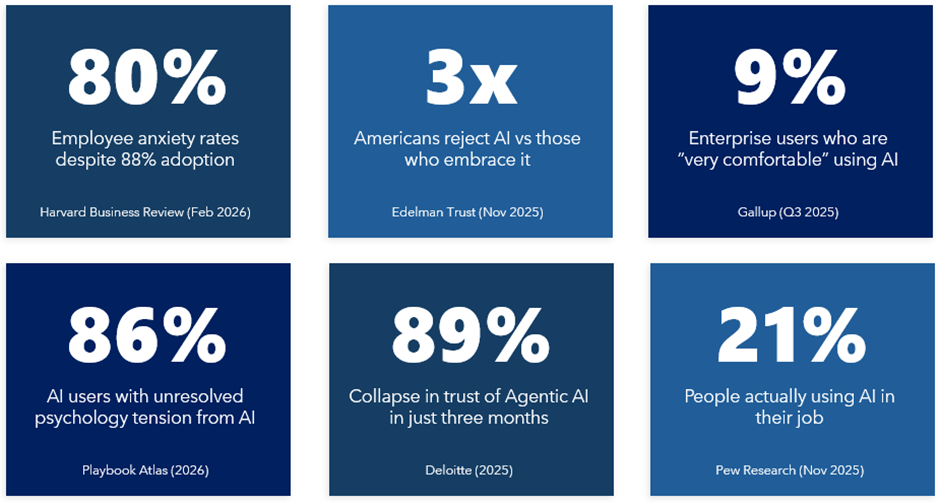
Leaders are extremely conscious that they have been caught out by the speed of change and the scale of impact from AI. People on the ground fear AI because they think it’s coming for their jobs. The managers in the middle feel anxiety because they have not been given the right framework and strategy to manage this change.
The true psychological threat is to people’s sense of purpose, mastery and challenge. We may like to dream of winning the lottery. But this is life with the cheat codes on: research consistently shows that lottery winners and inherited wealth elites struggle with hedonic adaptation and loss of meaning. You remove challenge, you remove meaning.
This is why the hero’s journey is about mastery. They are forced to leave home. They develop mastery. At the end of Act II, something catastrophic knocks the hero to the floor. In Act Three, it is mastery which allows them to overcome adversity.
When you apply AI in such a way that it robs people of challenge, of purpose, of discovery, of overcoming the odds within the workplace through the skill set that they have spent their lives developing, you remove the hero’s journey. This, unfortunately, is what 99% of adoption looks like.
I turn anxiety into agency. I don’t do AI for people, I show them how to do AI themselves. I don’t dismiss fear, I get people to lean into it and relabel it as progress. I don’t focus purely on efficiency, but how to 10x their effectiveness. I don’t remove challenge, I empower people to take on challenge they didn’t think possible.
Bayes Ltd
This is what I mean by psychology-first AI. My method ended up being a massive mix of things: stoicism and Bayesian reasoning to manage change, metacognition as a mindset for engagement with AI, a focus on risk to drive accountability, employee empowerment through Toyota Way thinking, and much more.
When I started a month ago, I had an engine but no vehicle. Over the past month, thanks to conversations with so many of you within my network, I’m seeing not one vehicle, but many.
This blog is the starting point for what I aim to turn into a whole platform for empowerment and enablement. I’m currently figuring out how to scale: the sort of content required, how to reach people en masse, making it accessible and engaging. I plan to provide this for free.
I’m exploring creating practitioners of the method, based on Agile. These can both be trained externally - AI consultants - and internally: AI champions. This brings an adoption framework which works to organisations and throughout society.
I want to build teams which can do tactical deployments within organisations: short-term campaigns which give people the mindset and knowledge necessary to chart their own course. Rather than endless spend on tools, people can build bespoke applications of AI themselves. You take the person closest to the problem, and support them in solving it with an AI-shaped crowbar.
The community of interdisciplinary problem-solvers I want to create will be able to apply their experience of challenges across a multitude of sectors to create solutions with genuine impact. We can offer these – free with API keys, at a subscription, or as a bespoke deployment.
My goal isn’t a consultancy – I remade MBB’s whole pipeline as a Claude plugin; the jig is up – but to create the world’s first post-AGI company. Bayesian strategists who empower others and know how to turn the skeleton key of AGI to the benefit of humanity.
What’s next
I do something which scares me every day. I’m constantly learning. I’m using what I know to support executives, companies and charities.
I’m still one guy with a strategy play in a world which rewards glitzy products. But I’m relentlessly building, refining, and looking to grow. I’m driven to do this because I don’t want to live in a world where we replace humans. I want one where we collaborate with AI to elevate us to new levels.
Here’s my near-term plan to delivering on that ambition:
- I launched this Substack to carry my enablement content. Subscriptions help me not panic every time I open my bank balance.
- My website will launch soon and include some of the plugins and tools I’ve been making.
- I’ll soon be taking bookings from impact creators – deep tech firms, social ventures, charities – and impact scalers – venture capital units, media.
- I’m open to fixed term fractional leadership roles or even a proper job if your organisation shares this ambition.
- I’m actively hunting people who can join me in getting this off the ground.
Finally, if I am to succeed in this, it needs to scale at the speed of AI. My current projection for AGI is two years. If this isn’t resolved by then, I’ll be moving up and mountain and down a bunker. As such, I would love to speak to potential backers or mentors who share my vision for what needs to be achieved and can help.
Thanks for reading. As always, a like, share or comment goes a long way. Do feel free to ask me any questions about all of this in the comments.