OpenAI says AGI has arrived, but is it actually useful?
OpenAI’s Astra dropped late last week, and the company says it heralds the dawn of AGI. The model lives up to that hype, but I can’t help but wonder if more power is what we need?


It’s become a running joke when I’m doing enablement that between when I prep the content and when I deliver it (often only a day or so in between), a lab will have put out an update that torpedoes the whole lesson. Such was the case last week giving a Gemini enablement session – which I prefaced with “no-one’s seen Gemini Pro in months, but a says tenner it’ll arrive by the end of this workshop”.
I asked Flash 3.8 – which dropped mid-session – and it thinks I’m at least owed a fiver.
Bookending the big week for new models were Fable and Astra. OpenAI launched Astra aka GPT-6 on Friday, giving poor old Fable 5.1 a measly four days as the incumbent top AI model in the world.
OpenAI’s marketing materials make Astra look like a J.A.R.V.I.S.-inspired AGI candidate – moth to a flame for a self-professed sci-fi nerd like myself. So, I spent the weekend finding out if it does indeed live up to the claims, and how useful it’s going to be for the average AI punter.
Astra-nomical
Given the AGI framing, I expected a whole new ChatGPT experience to come alongside Astra. When I booted up to find GPT Work, I was actually relieved. I’ve got into a real groove with the new harness (tips on how you can too here) and its now replaced Anthropic as my go to professional workhorse. Moving everything around again as AI goes space age was not what I wanted to be doing on a Saturday morning.
That said, the kick off conversation was far smoother, natural, and insightful than anything I’d previously experienced.
In preparation for this blog, I started with a variant of my standard use case prompt:
“Let’s have a think about where we could apply you - effective and efficient use cases in my work - but we’re not stopping there. Take a look at our chats, what you can find about me online, and where we can showcase your capability. Work with me back and forth and ask me any Qs, then let’s one.”
What I got back astounded me.
One of the ways I test new models is I get them to make a game. This started back with 4o, when I managed to strap together a basic space invaders clone over the course of an hour. When Codex dropped four months later, it did it all by itself in two minutes.
I hadn’t even thought about games when I sat down with Astra – but it found the graveyard of old builds on my hard drive while going through my other files. What it came back with – inferred from research, not my steer - was this:
“The research about the space you are operating in supports all the claims you make, further backed by your own hands-on experience and ROI metrics. The problem you face is that this is counterintuitive to how most perceive AI - so I’m going to make a game that allows them to experience it first-hand.”
My jaw was on the floor. Inferring that I’d likely want to do a game eval was impressive enough, but Astra had also identified the precise frustration I face professionally and wanted to do something about it.
Forward Deployed Leader: The Game
We proceeded to the back and forth. What do I see as an FDL regularly, what sort of obstacles do you actually encounter on the ground doing AI adoption, how does the psychology component play out in real life? Next – a lengthy chat about the gameplay loop, the look and feel of the game, and the underlying mechanics.
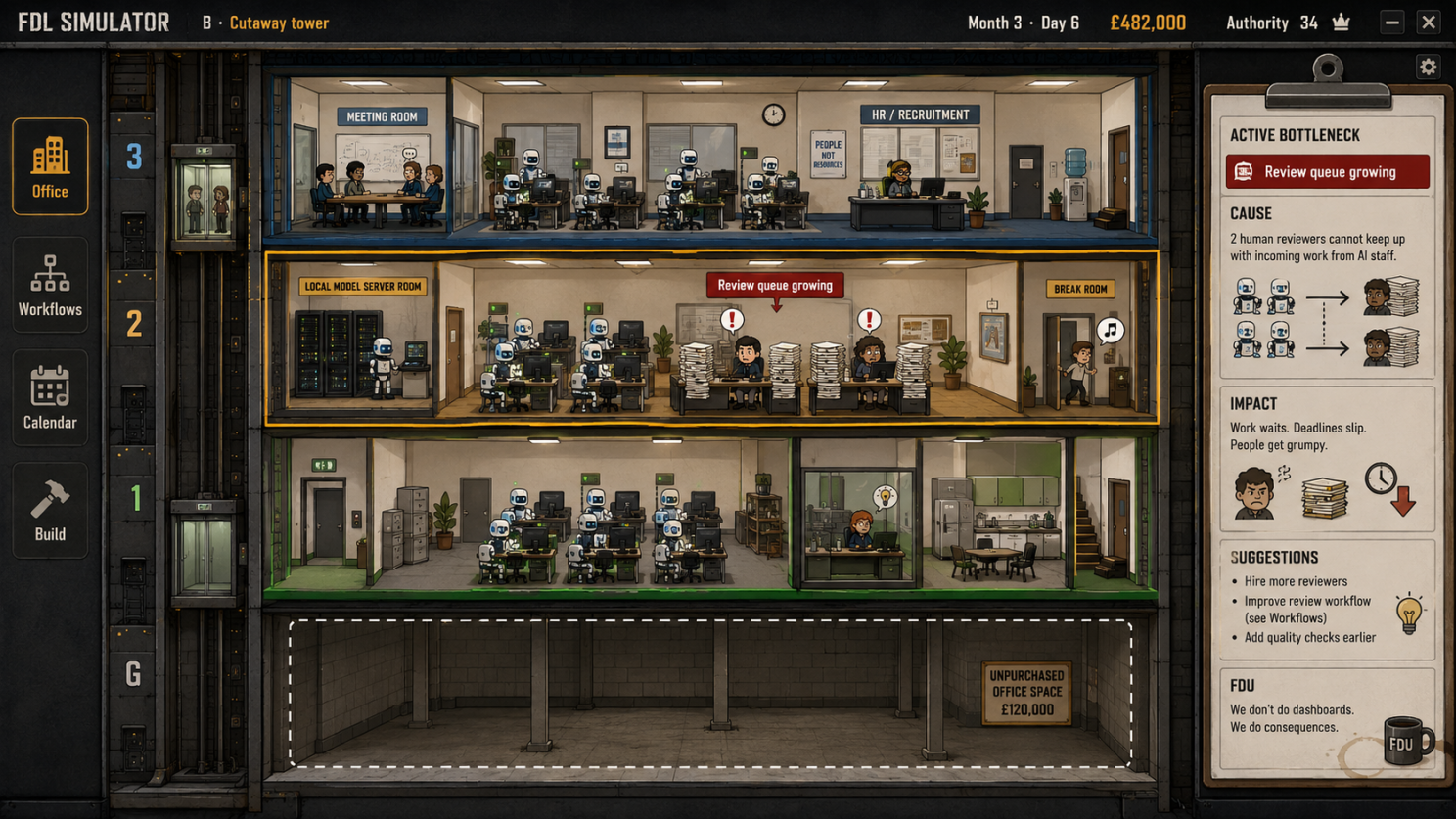
First concept art
What started as a clone of Fallout Shelter quickly transformed into a far grander vision –a halfway house between Theme Hospital, the Sims, and Rimworld. The blueprint for FDL Simulator was set.

Where we ended up
I’ve already got an effective agent orchestration GUI I built over the summer – Odin - which uses a build loop I put together – Mjolnir. But given the AGI framing, I wanted to see what happened when Astra was fully handed the wheel.
The only steer I gave it was to use Fable for review. I read our final plan, set Astra to Max on x2 speed, and then stepped away.

I fully expected Astra to drop the ball. I hadn’t just requested a demo or a shell of a game, but a full PC game. Two-Point Hospital, the modern-day successor to Theme Hospital, took a whole team of developers several years to complete. I wanted this and more from an AI pulling an all-nighter.
So when I woke up to find Astra had actually delivered, I struggled to believe it.
I spent most of Sunday playing it – and its actually kind of brilliant. Players can pick one of five archetypes – strategist, engineer, operator, communicator & commercial. You then select the type of business you’re going to deploy into – 10 in total, ranging from legal to fusion deeptech. The tutorial is lifted straight out of my work – you design a blueprint for AI adoption. Once complete, you layout your strategy with the C-suite, and the game opens up.
The depth is astonishing. How the player chooses to approach adoption deeply affects the game world. If you choose to coach everyone into powerusers but neglect psychology, the workers turn into actual AI vampires who never sleep and eventually burnout into piles of dust. If you suck up to C-suite but ignore the staff, they turn into saboteurs.
One run ended when the AI bubble burst suddenly which tanked the company and led to me getting fired, another when my sole vendor was blocked by the US administration. There’s even an AGI endgame. Empower people, and you get Deep Thought. Sack everyone, and you get Skynet.
To be clear: it still needs work. Yet, going from a conversation to a game I could legitimately ship soon in just 24 hours is awe-inspiring.
But coming away from the weekend, I realised something. The purpose of this exercise was so that I could demonstrate how Astra could be useful to you. Despite this incredible display of capability, Astra didn’t answer that question.
Bang for your buck
To make FDL Simulator, I ran Astra at Ultra on a 20x Max subscription with resets. The equivalent cost were I paying by the token is somewhere in the region of $4,000 – not bad considering the cost of the sub is a mere $200.
Yet step down the tiers to the $20 Plus subscription, and you’ll find forums awash with complaints that Astra can barely tie its shoes before it hits weekly limits. Now, while you should expect costs to go up with more complex requests for frontier models, the Plus subscription is equivalent to the tier most business users are on. Astra aside, Plus is insufficient to use harnesses like Cowork or GPT Work.
Consequently, I’ve had to escalate standard users to premium seats as they start to get into applying harnesses to their work (albeit on Anthropic). This unexpected jump in costs is likely why Anthropic’s Fable is seeing dismal levels of use. The power and potential here is clear to me, but the cost to benefit ratio – what a CFO will care about - is not.
I keep coming back to Loonshots, which compares the fortunes of American Airlines against Pan AM. The latter tenaciously pursued product-led innovation – bigger planes, faster engines – while the former went with strategy-led innovation in the form of frequent flier miles.
American Airlines made air travel sticky and useful, while Pan AM crashed and burned. Likewise, the labs pursue an agentic future which is yet to demonstrate actual value to the majority of people.
That failure to articulate the strategic benefit is costing them dearly. We’re a year removed from the infamous MIT paper slating the state of AI adoption, yet fresher research underlines that this remains an unsolved problem – Sam Altman himself confirmed this last month.
That same cost/benefit question CFOs have is one being asked by society at large – and the AI industry’s failure to answer it is driving sentiment against the technology. Without a coherent answer, we risk seeing AI fall into the same pit of negativity nuclear power lives in – and not even Astra will be able to climb out of it should that happen.
Astra in of itself does not answer that question. But, at the very least, it can make a game that demonstrates why hands-on enablement that empowers people does.