An AI expert's guide to being unemployed
Ten years ago, redundancy put me into a mental tailspin. A decade later I'm the AI guy who can't find work because of AI. The economy's plan, it turns out, is that there is no plan.

Ten years ago, I was made redundant.
To complicate matters, I was 12 months into a mental tailspin. Thanks to the stiff upper lip attitude toward mental health, I’d spent the majority of my life oblivious to the existence of anxiety.
The penny dropped like a nuclear piano.
My cortisol-addicted amygdala had tired of controlling my life from the shadows. As I approached thirty, it emerged from its ancient reptilian pit of fear in my brain, manifesting as crippling burnout.
A decade later, I get a photo on my birthday from my Dad. It’s the two of us from my 31st.
I looked like shit.
I also looked like the guy who would overcome my demons.
It reminded me of conversations I was having at the time about worth, value, and purpose. Questions which would cause cognitive shifts in how I perceived myself.
Questions, it occurred to me, that we should all be asking about where we are heading as a society.
The ever-changing professional self
Many of us define our place in society through our professional identity. How we perceive our status, what we offer, and what we’re worth stems from what we do.
I define myself as a writer. When computers start writing for themselves, you tend to pay attention.
Consequently, I’ve spent much of the past decade diving into AI. Since Covid, my interest has been catalysed by existential urgency.
I invested heavily, and it paid off. I went from communications guru to leading AI adoption for a FTSE 250.
Yet, despite being damn good at it, I nonetheless face the same professional challenge of redundancy as my younger self.
When I told the guy down the Jobcentre what my last job was, he said:
“You’re probably the only guy I’ve seen all month who’s not going to struggle finding work.”
A good couple of hundred applications later without a callback, and I’d beg to differ. One of the deep ironies of my current situation is that AI has made it harder to get a job, not easier.
Everyone is applying with pitch-perfect CVs. They even teach you to do it in the Jobcentre. I blew my work coach’s mind when I made him an agent for sourcing and applying for jobs. He thought it was amazing, I knew I was just making a bad situation worse.
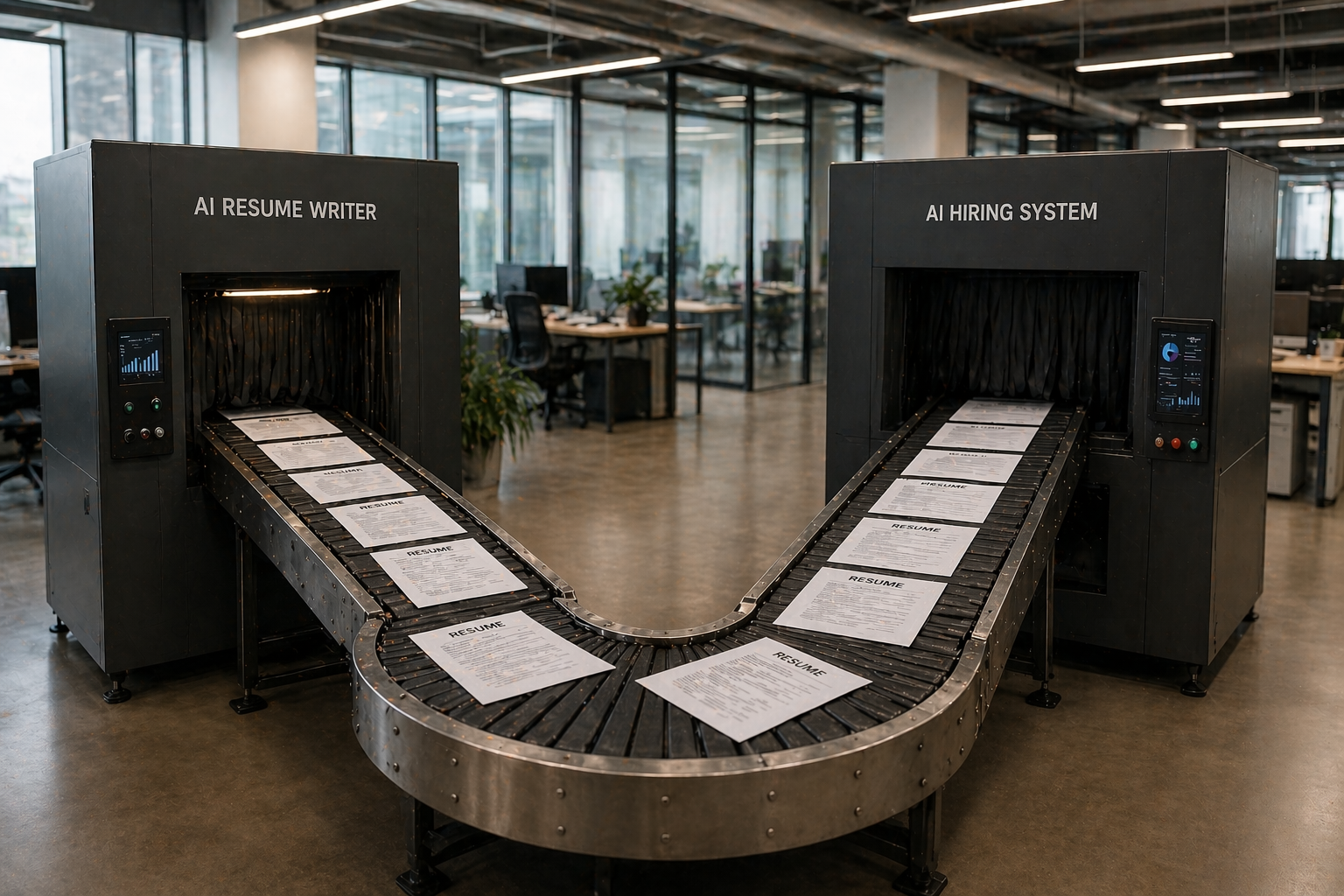
In response, recruiters brought in AI. Slop begets slop. The end result: no one reads your CV, companies hire bullshitters who can prompt, and real talent doesn’t get a look.
Even if you lean into AI, as I have, you won’t be stepping into a new land of plenty. Unless you’ve got 10+ years of AI/ML under your belt, you won’t get a look. In another ironic twist, companies recruiting for AI roles don’t comprehend the skillsets necessary for AI adoption are not computer-based, but people-shaped.
All the while, AI eats away at jobs. Software engineers. Office admin. Finance teams. Therapists, customer service staff, journalists. Professions are rapidly becoming features.
Those that still exist have AI dumped on them by execs and are expected to figure it out. Without guidance, people offer up the work that gives them purpose to the machine. Robbed of meaning and challenge, these workers wither into professional shells of their former selves.
The biggest technological earthquake since the internet is eroding our professional selves.
Mr Roboto, Job garroto
It’s a nice line I’ve seen used that ‘AI will destroy jobs but create new ones’. After all, this has been true every time you’ve had a technological revolution.
Shame it’s bullshit.
Many erroneously describe AI as a tool. This implies that it needs someone to wield it. The truth is that it is an intelligence, and it is getting smarter all the time. Don’t be fooled by grifters posting gotcha AI memes for upvotes: Mensa rates my IQ at 155 and AI blows me out of the water.
How we apply that intelligence is essentially the whole AI game in a nutshell. There are various competing visions for this. DeepMind’s Demis Hassabis wants it to solve mankind’s greatest challenges. I want to see it augment and elevate human work, amplifying our impact. Elon Musk wants it to provide erotica to teenagers.
The approach many companies are in pursuit of though is using this intelligence to eliminate the need for a human entirely.
One former colleague told me that this wasn’t a problem as AI will do all their work for them. It hadn’t occurred to them that their employer may stop paying them if this becomes the case.
When a machine can do your job better than you at a fraction of the cost, there is no new job waiting for you.
If you think you’re immune, you aren’t. The exponential acceleration curve is real and it’s genuinely terrifying. The pace is faster than anyone can comprehend, let alone legislate or regulate.
Of course, we now have the ability to build pretty much anything. The problem is that the foundations are quicksand. Positions that were defensible are now breached. Whole industries can be turned into a new feature. Who’s going to buy your product when they can replicate it with a prompt?
Meanwhile, a madman tweets about wiping out civilisation. There’s a million flavours of bland arriving soon on stream. Our window on the world becomes an atomised locked-down box of crack-co-content.
We lack both the ability and bandwidth to process any of what’s happening.
Your profession can be commoditised.
You’re ten years too late to move into AI.
Anything you make can be instantly copied.
Somewhere, deep inside its lizard cave, your amygdala huffs in and out of a paper bag.
Jobs for the roboys
Productivity. Optimisation. Engagement. Today’s world is geared for speed. We’re always sanding off a corner here, smoothing a wrinkle there. Frictionless, pre-packaged, and by the numbers. Endlessly summarising until every email is just the word ‘regards’.
On LinkedIn, the millionth status about em-dashes is finally posted. It gets more likes than my entire AI Bayesics series combined.
My RSD screams into a pillow. The pillow promptly rejects it.
One guy has posted about some posh kids cashing in on AI. Another one wonders why Gen Z don’t like AI.
I know why.
Gen Z faces the same economic hardships as the millennial generation, but magnified. They wanted climate action, and we gave them wealth extraction. Digital space monkeys fired into social spaces from birth, a whole generation beta-testing a life lived virtually.
We barely let them yeet trainer socks into oblivion before AI came along and yeeted their future careers.
I’ve had a lot of concerned parents ask me what their kids should be studying. Elon Musk seems to think they’ll be happy collecting Universal Basic Income and playing Xbox.
But without professional meaning, without purpose, Gen Z and everyone else is sleep-walking into a psychological cataclysm.
The paths ahead
Our current use of AI is a tightrope walk. If we fall on one side, chaos. If we fall on the other, dystopia. If we stop walking forward, the consequences of a century and a half of technological hubris will catch us.
But there is a future at the end of the tightrope. To get there, we must start to visualise it.
We cannot leave this in the hands of our political leaders. The defining political fight of the 19th and 20th century was between conservatives wishing to retain wealth and workers looking to attain it. While wealth inequality continues to cripple genuine growth, few politicians speak to the struggle ahead.
Simply put, they’re as clueless about where this is going as the rest of us.
Presently, we appear locked in a race to the bottom. AI is poised to sweep a scythe through work. Musk’s suggestion of UBI is one shared by many thinkers in this space, and one I agree with.
Tax wealth, assets, and AI-based companies heavily. Redistribute so people don’t throw Molotovs at data centres.
But what becomes of craft, a professional sense of worth, and purpose in such a world?
That is what we must begin to conceptualise and work toward. A world where people are free to pursue their passions. A society where status and value are defined by what you give back to society, not what you’ve hoarded from it offshore. Work not for monetary gain, but for the sense of mastery and overcoming challenge which defines a life.
Or you can keep telling yourself that AI can’t replace you and I’ll see you soon in the Jobcentre.
Thanks for reading. Shares, comments and subs are very much welcome.